www.theflowerbin.net

www.theflowerbin.net

Tuesday, August 11, 2020

 Have you ever wondered how we find most of our new varieties, year after year?  Do you ever wonder how we plan for each new year? 

Well, planning for next year begins now and it begins here. 


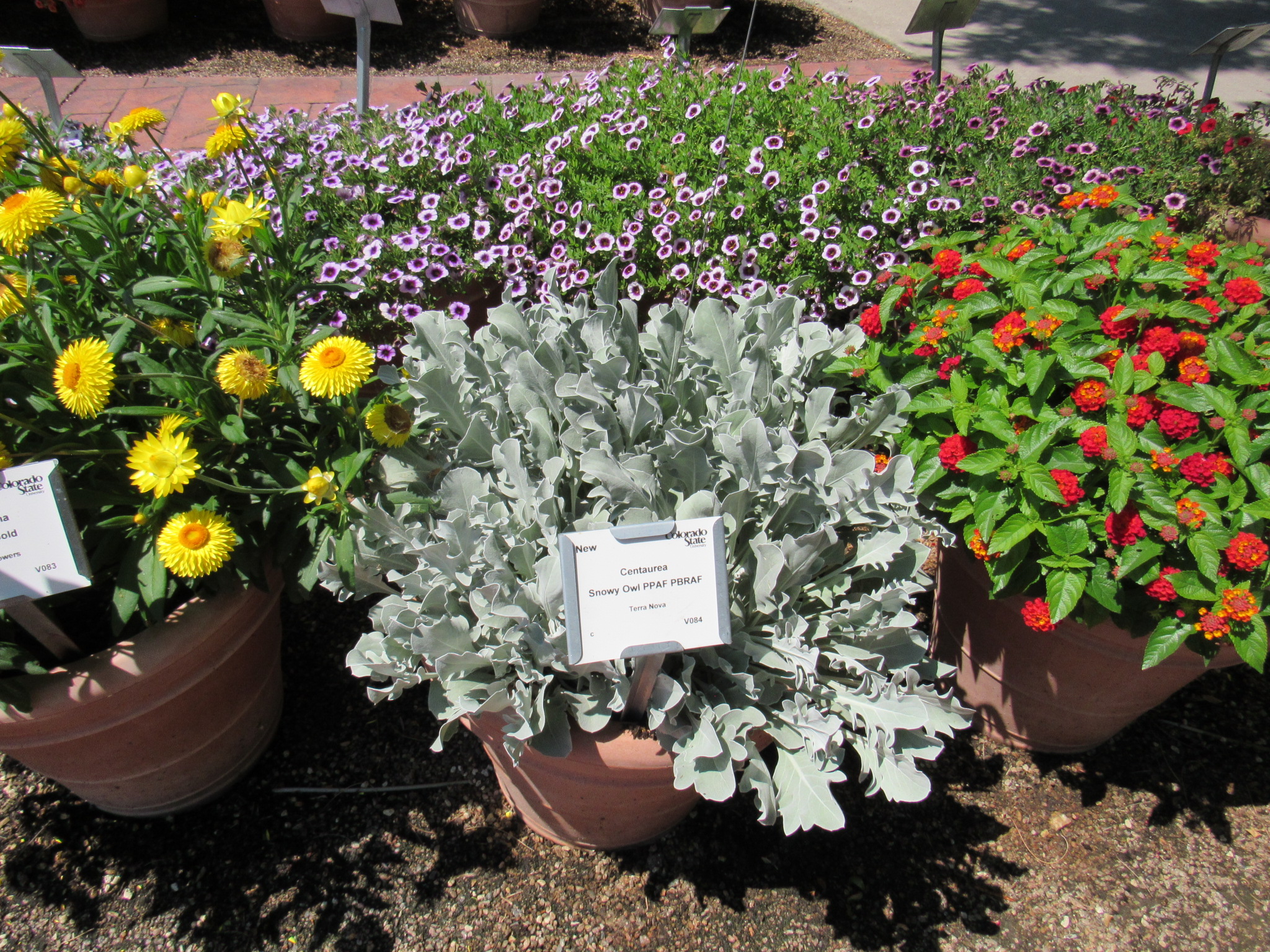
Each year, in early August, we travel to Fort Collins to visit the Colorado State University Trial Gardens to see what’s new. 

 Our inspiration and ideas are close.  

Plant breeders from all over the world send seeds or cuttings (in spring) to CSU to be evaluated in the CSU gardens.  Several growers in the state start them in their greenhouses until it is safe to plant them outside.  Then, master gardeners and horticulture students plant them and care for them all summer.  The idea is to see how these new selections grow here in Colorado with our specific challenges.   It can be very eye opening!  For example - 

 we have always sold these Elephant Ears to grow in the shade in Colorado ** (which they do very well).  Imagine my surprise when I saw these beauties doing very well in the full hot blazing sunshine! 


When we see a special plant in one of our new catalogs, it is always fun to come to CSU to see just how well it does here.  At the CSU gardens, all varieties are grown two ways:  one is planted in the ground and one is planted in a pot.  It can be a world of difference between the two! 

Here is an example of how the plant looks in the catalog (Image Credit Park Seed Company)

and again at the plant trials 

Undecided on whether to try it or not.  Petunia Shock Wave Purple Tie Dye.  


Another thing we look for is improvement on the prior years’ plants.  While we always try to choose the best plant with the most flowers we can, sometimes, find an even better example.  Check out this pink calibrachoa with all of those flowers! 


And, of course, we are always looking for something that really catches our eye, because we know it will catch yours as well. 


If you love Dahlias as much as we do, you would love the garden bed devoted to dahlias.  Pink, red, yellow, white flowers over green or almost black foliage.  Here are a few of my favorites: 


If you want to spend part of a day in a lovely, serene setting, take a trip to Fort Collins and visit the trial gardens.  They are open to the public all of the time, there is no charge to visit AND you can take the kids and let them run around.  What better way to spend a day! 

If annuals are not your thing, right next door is the perennial trial garden.  Come and see what is new on the horizon for next year.  Be sure to take a tour around the demonstration garden.  Even Denver Botanic Gardens can’t beat this one! 


Well, it’s on to the next step of planning…pouring through the 50 or so catalogs we get from growers and breeders across the country.  If you see something you would like us to have, be sure and give us a call and let us know. 


**Living in Colorado can bring its own challenges.  One of them is the intense sunshine.  As we are a mile closer to the sun and we are very dry with little to no humid cloud cover, many plants can get fried if they get too much sunshine. 


Tuesday, August 4, 2020

Now’s the time to Revive® your lawn


  There is no doubt summer can be tough on your lawn. Your once green grass is dying off and no matter how much you water, the brown patches just seem to grow. Based on the turf samples we see daily at our Diagnostic Center, this is a common problem for many lawns in the area. 

Some summer lawn problems come about due to poor mowing and watering practices. At this point in the season, your mower should be raised to its highest setting and you should be mowing twice a week. Mowing higher and more frequently will reduce moisture loss and minimize heat damage. Watering correctly is important too. Watering your grass every day encourages shallow root systems. When the weather turns hot and dry, these short, shallow roots can’t deliver enough water and your grass begins to dry up and die. A better approach would be to water deeper and less frequently. This will encourage grass roots to grow longer, reducing the heat stress effects on your lawn. In addition to applying good watering and mowing methods, it’s important to improve the soil your lawn is growing in.  

The keys to building better soil in existing lawns include: spring and fall aeration, regular applications of organic material and using granular Revive® three times a year. Revive® is a local product designed to improve soil structure which in turn, encourages strong root development and optimal water and nutrient uptake. By using Revive® the water you put on your lawn moves down to the roots more effectively and there’s less loss due to evaporation and run off. 

Revive® is also available in liquid form, which is handy to use to correct soil compaction, restore grass damaged by pet urine, as well as grass burn caused by rabbits.  In conjunction with Revive® we recommend you include humate in your lawn maintenance schedule. Humate is a highly concentrated soil conditioner derived from the remains of decomposed organic plant materials.  Feeding your lawn humate will make your soil healthier, increase microbial activity and enhance nutrient uptake. 

Humate is available in granular form in Natural Guard HuMic. You apply it using a fertilizer spreader.  Both Revive and HuMic are chelating agents.  Chelating agents increase nutrient availability to plants. This means more of the fertilizer you put on your lawn goes to feed the grass. Just like any other plant in your garden or landscape, your grass is only as good as the soil it is growing in. Regular applications of Revive® and HuMic combined with sound mowing and watering practices will help ensure a healthy lawn through the rest of the season.