www.theflowerbin.net

www.theflowerbin.net

Tuesday, July 23, 2013

It’s Time to Divide Bearded Iris


Over time, iris become crowded and they stop blooming, so it’s important to dig and divide iris about every 3-4 years in order to reinvigorate the plant. 
Iris grow in clumps and the root of an iris is called a rhizome. It is the rhizome that we are going to lift carefully, using a garden fork. You can use a shovel, but be careful to not damage the rhizomes.
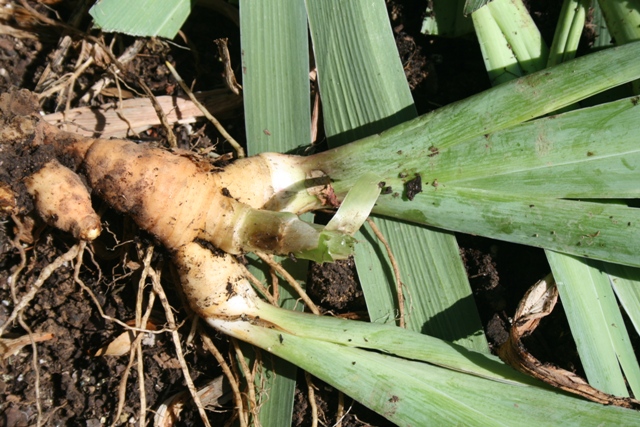


Once out of the ground, cut or break apart the rhizomes into sections,  with a healthy set of leaves and firm, tan/white roots.
Get rid of rhizomes that are soft, mushy or have holes in them. Dust the rhizomes you keep with Sulfur. 
Next, cut the leaves back to about a third of their length.
You are now ready to re-plant. Iris rhizomes grow away from the toe, in the direction of the heel, so keep this in mind as you plant. Iris need well drained soil, so take time to amend your soil with Sheep, Peat and Compost. Add some Bone Meal and place the rhizome in the hole, roots spread out and cover with soil deep enough to just cover the top of the rhizome. Water well and add more soil if necessary. Your iris will establish themselves through the fall and early winter and be ready to bloom for you next spring.

Tuesday, July 16, 2013


This is the time of year when you notice that your geraniums have suddenly stopped blooming. If you look closely you might discover some holes in the buds. Your plants have fallen victim to tobacco budworms.
 Shown here, tobacco budworm caterpillars chew into the flower buds, the buds fail to open and your geranium stops blooming. Budworm will also damage petunias and penstemon, causing the plant to stop blooming. You can control budworm by applying products containing Bt (Bacillus thuringiensis).


 You can control budworm by applying products containing Bt (bacillus thuringiensis). Dipel is a dust which can be applied directly to the plant. Thuricide is a concentrate, which is mixed with water and sprayed on your plants. Dipel and Thuricide are biological controls that get rid of budworm.


Allowing spent flowers to remain on the plant can also slow down bloom production. You want to remove flowers as soon as they begin to fade, to encourage new flower buds. This is known as deadheading. Deadheading is the process of removing the flowers as they begin to fade. You want to remove the flower petals as well as the stem it’s connected to.


Follow the flower stem back to the main stem and clip it off, using a sharp pair of garden scissors. Check the plant and remove any fading flower clusters.

By keeping up on deadheading, watering regularly and fertilizing with a well-balanced fertilizer such as Fertilome 20-20-20, your geraniums will stay healthy and blooming for the rest of the season.